

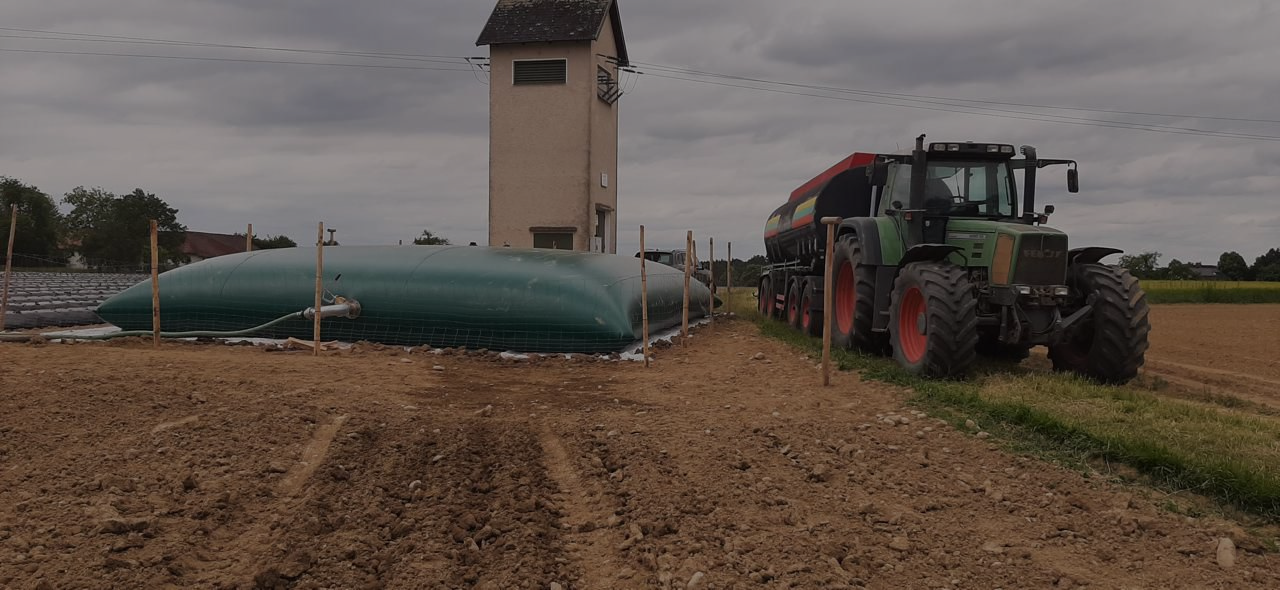
flexible tanks installation
Flexible tank: calculate its ideal volume in five minutes

Rainwater: calculate the volume of your flexible tank in just 5 minutes
Faced with the problems linked to global warming and the issue of water becoming increasingly scarce, you’ve decided to equip yourself with a flexible tank. Easy to install, robust, and economical, it will help you maintain your garden, especially your vegetable patch, and possibly for other tasks like washing, while also saving money. But you’re wondering about the ideal size of tank to meet all your needs: a few hundred liters, several cubic meters? Estimating your consumption isn’t that complicated: here’s a step-by-step guide to choosing the right volume without making a mistake.
1 Calculate the volume of rainwater you can collect
First of all, you need to know your available capacity, which is, the volume of rainwater that can potentially be collected. To do this, two pieces of information are essential.
Rainwater collection area
Rainwater collection is done through gutters that collect water from theroof. Do you have a house, a garden shed, or a shed, or all three? You need to know the roof area of your building(s). Don’t worry about complex calculations that take into account the slope of your roof: the roof area is considered to correspond to the building’s footprint. A house measuring 15 meters by 8 meters, for example, will be considered to have a roof area of 120 m2 (15 x 8 m).
Local rainfall
The amount of recoverable water varies significantly by region. This datais available on the Météo France website or from local authorities. Theseare annual averages. Here are some approximate figures formetropolitan France:
. Brittany (mountainous foothills): 900 to 1,200 mm/year
. Île-de-France/Centre: 600–750 mm/year
. Mediterranean shores, Provence-Alpes-Côte d’Azur: 450–650
mm/yearRemember: 1 mm of rain on 1 m² = 1 litre of water collected (before losses)
2 Introduire un coefficient de perte pluviale:
It’s important to know that not all the rain that falls on a roof ends up in the cistern: the roughness of the roof, its absorption capacity, and debris that blocks runoff all have a slowing effect. It is therefore necessary to apply an overall efficiency coefficient that incorporates: The roof’s runoff coefficient, depending on the material used:
. Tiles, slates: coefficient of 0.85–0.95
. Sheet metal, steel deck: 0.90–0.95
. Bituminous roof terrace: 0.80–0.90
. Green roof: 0.50–0.80
The “first few liters” losses are due, among other things, to filtration. The very first millimeters of each rainfall carry dust, pollen, and leaves; a filter basket traps these impurities. Allow for an additional 5 to 10% of losses.
Don’t complicate your life with overly sophisticated calculations. All you need is a realistic estimate. You can use an overall rate of 0.80–0.85 (e.g., 0.9 runoff × 0.9 filtration = 0.81). You won’t have any problems with your cistern.
3 Consider uses: What will the rainwater be used for?
The required volume depends not only on your rainwater harvesting capacity, but also on your consumption. List all your potential uses and convert them into average daily requirements (number of liters needed/day). Here are some estimates for the main types of use:
Watering vegetable gardens and flower beds. Using a drip irrigation system and mulching plants: 2–4 L/m²/day in summer. Much less in the spring and summer. If you water with a hose or an oscillating sprinkler, these figures can easily double.
Maintaining small greenhouses. It’s often necessary to water 3–6 L/m²/day during warmer periods. Greenhouses also require more frequent watering than outdoor crops during cooler periods.
Cleaning decks, tools, a car… this varies greatly: expect between 10 and 50 liters per use. Estimate your monthly usage and adjust the watering accordingly.
Household Uses:
Toilet Supply: Flush: 3-6 L per flush (dual flush). This represents 15 to 30 L/person/day depending on usage.
Washing Machine (with rainwater if properly installed): 40–60 L/cycle. This represents 20 to 40 L per day if used 3–4 times a week.
Warning: Remember that there are fairly strict regulations regarding the use of rainwater for household purposes. Rainwater is not potable and requires a specific installation, including filtration and backflow prevention devices.
4 Calculate the usable volume based on seasonality
Even with a good water collector, water supplies are irregular: most of the rain falls outside of summer. You must therefore manage your tank according to this data and be able to access water in the middle of summer. Make sure to:
Aim for realistic autonomy (30 days for a garden, 45 days for a greenhouse, for example). Adapt according to the region and the possibility of long periods of drought;
Add a 20–30% margin for exceptional “drought” events; Also, consider overflow discharges. Heavy rains—increasingly frequent— can cause an overflow that your tank will not be able to absorb. Plan options for recovering this water: a swale, a pond, or a second tank for occasional storage.
5 Use the quick formula to choose your flexible rainwater tank
1 Calculate the annual collectable rainwater volume
Annual volume = Surface area (m²) × Rainfall (mm)/1000 × Loss coefficient
For example, if we use a loss coefficient of 0.81 (0.9 × 0.9), we obtainthefollowing results:
| Roof Surface | 500 mm/year rain water | 700 mm/year rain water | 1000 mm/year rain water |
| 50 m² | 20,2 m³/year | 28,4 m³/year | 40,5 m³/year |
| 100 m² | 40,5 m³/year | 56,7 m³/year | 81,0 m³/year |
| 300 m² | 121,5 m³/year | 170,1 m³/year | 243,0 m³/year |
2 Estimate the volume of rainwater needed for your uses
Need (m³) = Daily need (L) × Target autonomy (days)/1000
Add a safety margin of +20 to +30% to cover a dry spell.
Flexible tank size: 3 concrete examples
House with garden (100 m² roof, 700 mm/year)
Potential collection: 56.7 m³/year Target summer requirement: toilets (2 people × 20 L) 40 L + watering(100 m² land × 2 L) 200 L + washing machine 8 L = ≈248 L/day Desired autonomy: 20 days → 248 × 20/1000 = 5.0 m³ 30% margin, i.e. 6.5 m³ usable Recommended volume (0.85 usable rate): 6.5/0.85 ≈ 7.5–8 m³
Small irrigated vegetable garden (50 m² roof area, 700 mm/year)
Potential harvest: ~28.4 m³/year Summer requirements: watering a 120 m² vegetable garden × 3 L =360L/day
Desired autonomy: 15 days, or 360 × 15/1000 = 5.4 m³ 25% margin, or 6.8 m³ usable water.
Recommended volume: a 7-8 m³ flexible tank
Professional vegetable tunnel (Building with 300 m² roof, 700 mm/year)
Potential collection: 170 m³/year
Summer requirements: 300 m² greenhouse × 3 L = 900 L/day
Autonomy: 30 days, or 900 × 30/1000 = 27 m³ required 20% margin, or 32 m³ usable. Suitable equipment: a 40 m³ flexible tank.
In all cases, it is essential to use the estimated summer consumptionasastarting point when sizing the tank. The maximum limit is determinedbythe roof area.
Identifying the right size for your flexible tank can be done in just afewminutes with the right data: roof area, annual rainfall, efficiency coefficient, and usage profile; you can’t go wrong. You’ll be able tobenefit from storage that’s easy to install and use, which will enableyouto never run out of water for your garden, while making substantial savings
 Basic cisterns
 Standard cicterns
 Fire-fighting tanks
 Potable water tanks
 Retention bassin