
flexible tanks installation
Fire Water Storage and Flexible Tanks for Isolated Properties

Fire Tanks on Isolated Land: How to Protect Your Home and Crops
Increasingly long and intense droughts significantly raise the risk of wildfires, sometimes leading to devastating consequences. Living near woodland, forests, or dense vegetation therefore requires great vigilance. This is especially true for many isolated homes, farms, and facilities that are difficult to access. Having a permanent water reserve is a critical safeguard. A flexible fire tank offers a simple and effective solution — provided it meets safety standards. Regulations, tank selection and installation, inspections… this article explains everything you need to know.
What Regulations Apply to Fire Tanks?
There is no single national rule. Each mayor is responsible for external fire defense (DECI) in their municipality, in accordance with Article L2213-32 of the French General Code of Local Authorities.
Fire Rules and Inspections: A Shared Responsibility Between the Municipality and the SDIS
The mayor establishes the DECI framework through a municipal bylaw, defining fire protection on the commune’s territory. Among other duties, the mayor must:
- Provide the local Fire and Rescue Service (SDIS) with an up-to-date list of all water points that can be used for firefighting;
- Ensure that this list is kept current at all times;
- Organize regular technical inspections of these water points (volume, flow rates, pressure), carried out by the SDIS;
- Notify the SDIS immediately if a water point becomes unavailable.
Key Requirements for Installing a Fire Tank
Before installing a fire tank on private land, it is essential to consult both the municipal bylaw and the local SDIS to understand specific requirements depending on the type of risk: isolated residence, farm, warehouse, or livestock facility. In general, compliance must include:
- Technical standards: NF S 61-213 (hydrants and standpipes) and NF EN 14284 (fire hydrants).
- Availability and exclusivity: the fire reserve must remain permanently available for firefighters. If rainwater is also used for irrigation, washing, or other tasks, a sealed and dedicated volume must be reserved for fire use.
- Easy, permanent access for firefighting vehicles.
- A suction connection: the number of 100 mm outlets depends on tank size — one outlet below 120 m³, two outlets above.
- Clear signage to mark the fire reserve.
- Appropriate volume adapted to the site.
Why Choose a Flexible Fire Tank?
There are four types of fire reserves:
- Underground reserves (steel tanks, usually large capacity),
- Above-ground rigid reserves (silos, elevated tanks),
- Open water reserves,
- Flexible tanks.
A flexible tank offers several advantages for isolated sites or agricultural use:
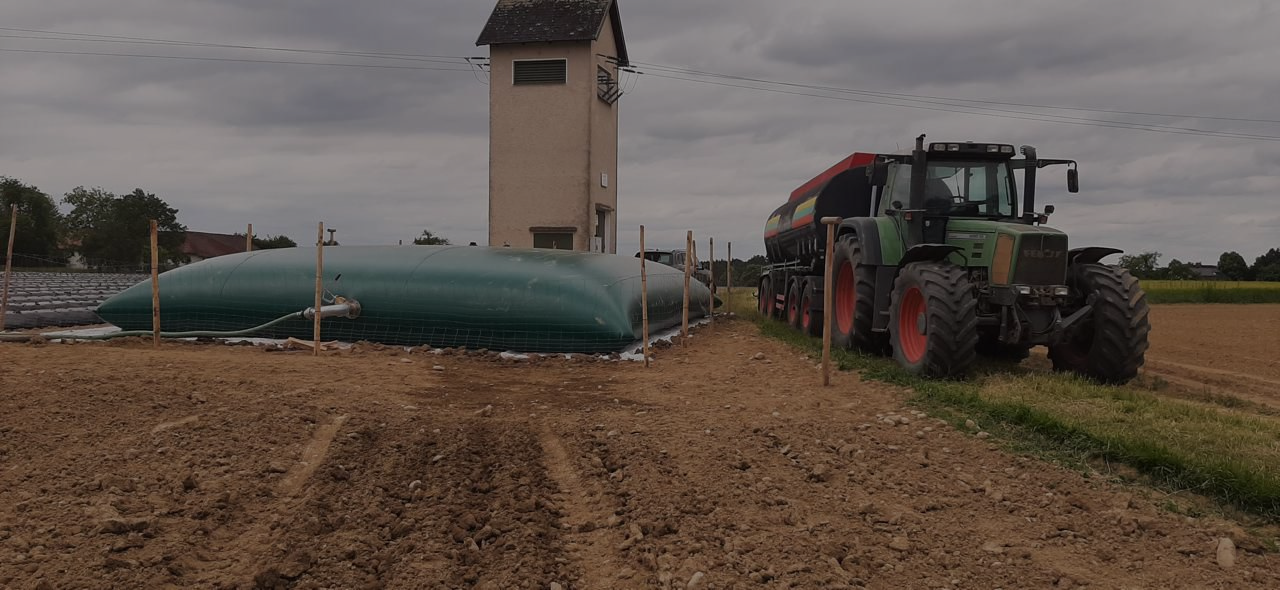
- Easy installation: no excavation or lifting equipment needed. Simply choose a flat surface, lay down a ground mat, unroll the tank, connect it, and fill.
- High durability: technical fabrics with UV resistance, watertightness, and tolerance of extreme temperatures (up to 70 °C).
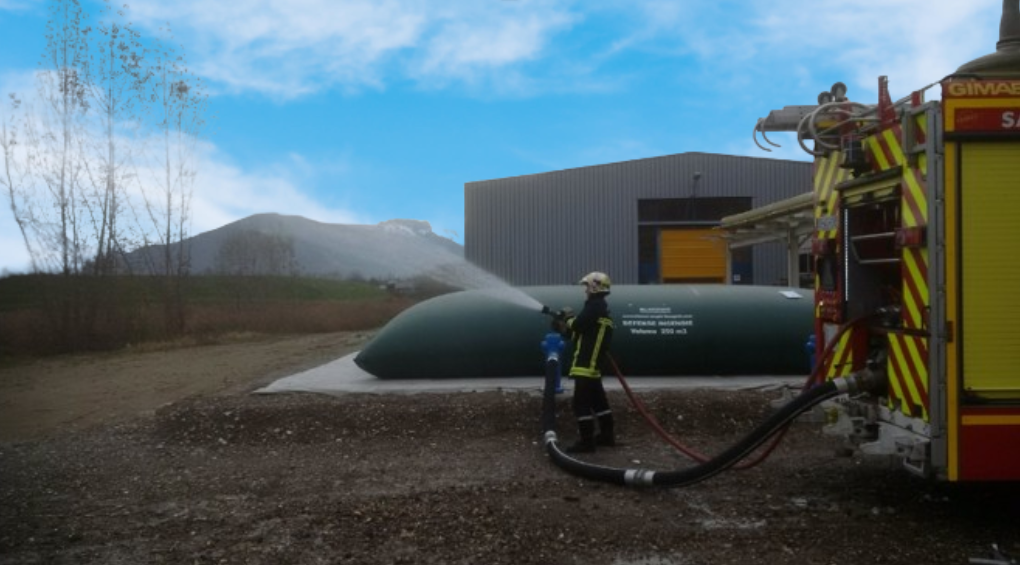
- Maximum safety: sealed volume, lockable valve, dedicated firefighter coupling.
- Flexible use: rainwater storage can coexist with the dedicated fire reserve (irrigation, livestock), and additional tanks can be connected in series if the SDIS requires greater volume.
- Tailored capacities: at SERENA, fire tanks are available from 30 m³ to 2,000 m³.
- Cost-effectiveness: far more affordable than rigid steel or concrete tanks.
5 Tips for Ensuring Compliance and Operational Readiness of Your Fire Tank
1. Consult the SDIS to determine the required volume.
In general, a residential house located away from other buildings requires a fire reserve of at least 30 cubic meters. Depending on the size of the building and the identified risks, the required volume may increase to 120 m³.
A farm or storage barn requires larger volumes, depending on the surface area and the materials stored. For an average farm, a tank of 120 to 240 m³ is sufficient.
For industrial facilities and more complex, large-scale sites, significantly higher volumes must be planned.
2.Choose the right location.
The installation site must:
- Be flat and free from sharp objects that could damage the liner;
- Guarantee year-round accessibility;
- Be located in a secure area, away from combustible materials (hay, fuel tanks, gas), trees, or other fire hazards;
- Maintain safe distance from buildings to ensure access even if structures are burning.
3. Install firefighter fittings and accessories compatible with the requirements of the civil defense department .
After consulting the SDIS, verify compatibility of the installation with firefighting accessories and fitings:
- Standardized outlet, usually DSP/Guillemin DN100 (sometimes DN65), to be verified with SDIS
- Protected valves and taps (bollards), independent filling point (tanker truck, network, rainwater collector);
- Level monitoring (fix an external gauge or reserved-volume marker).
4. Secure access to the tank.
Firefighters must be able to access the fire tank quickly under all circumstances. To ensure this, several precautions must be put in place:
- A reliable access road for fire trucks: the path must be stabilized, at least 3.5–4 meters wide, with a clearance height of 4 meters. Firefighters must be able to set up on a flat suction area close to the connection. In addition, it is recommended to regularly clear the surrounding land to maintain visibility.
- Clear signage: this includes installing complete and easily identifiable signage, as well as reflectors for nighttime visibility.
- Physical protections: placing bollards in front of the valve and fire connection to prevent vehicle impact, and fencing to protect against damage caused by animals.
5. Ensure regular maintenance.
A fire reserve must remain operational 365 days a year. Continuous monitoring is essential, which involves:
- Regular visual inspections, at least quarterly: checking for cracks, abrasions, punctures, or deformations on the tank, verifying the water level (respecting the minimum reserved volume), and examining the condition of fittings, valves, and caps
- Periodic suction tests: in coordination with the SDIS, conduct a test (e.g., annually or every two years depending on local practice) to check fire truck access, connection to the firefighter coupling, priming, and flow rate. The goal is to ensure that the water supply can be used immediately.
- Maintaining a logbook: recording the dates of inspections, interventions, repairs, and communications with the SDIS. This record is useful for insurance purposes and operational safety.
- Accounting for weather conditions: flexible tanks withstand freezing water, but components such as taps, valves, and gauges must be protected with insulated covers.
On an isolated property, a fire reserve is a life-saving safeguard for a home, crops, or agricultural buildings. A flexible fire tank is a particularly practical solution: it can be installed in just a few hours and ensures safety, durability, and cost control. Need turnkey support? SERENA will help you choose your tank and configure the fittings to meet local requirements.
 Basic cisterns
 Standard cicterns
 Fire-fighting tanks
 Potable water tanks
 Retention bassin